

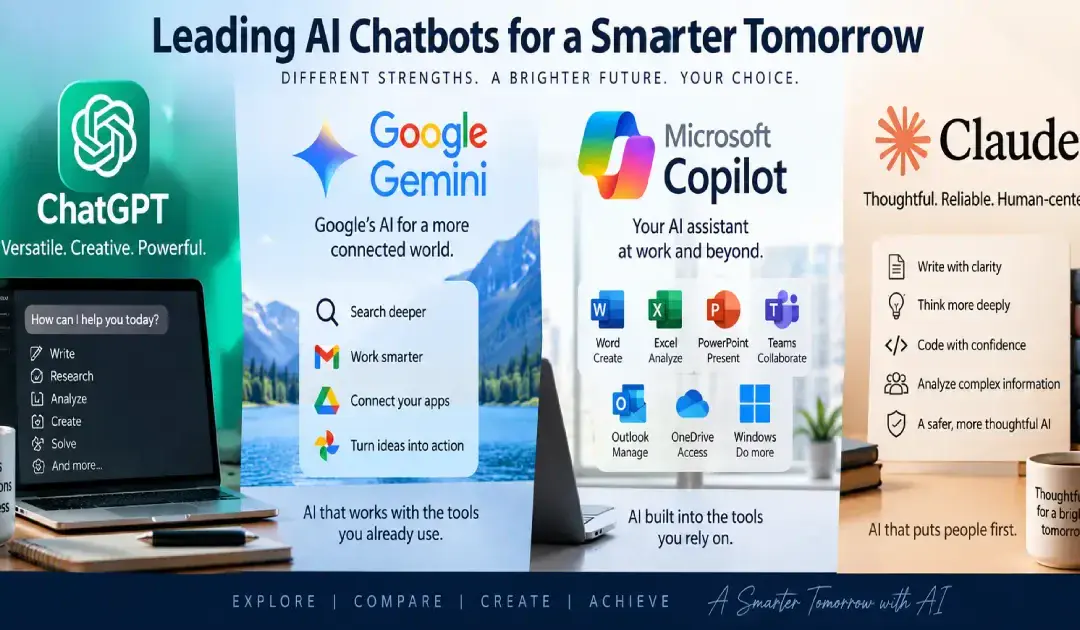
Artificial intelligence (AI) chatbots have evolved from tentative, experimental tools into formidable digital assistants that can investigate virtually any subject, compose polished content, interpret and analyze documents, generate code, create compelling images, and help people complete everyday tasks more efficiently.
Four platforms increasingly shape conversation: ChatGPT, Google Gemini, Claude, Microsoft Copilot.
They handle many similar tasks, but are quickly becoming distinct products.
So picking the best chatbot isn’t about finding the universal “smartest” AI; it’s about stating what you want the AI to do.
ChatGPT: The Versatile All-Rounder
OpenAI’s ChatGPT is arguably the most versatile among the four chatbots, seamlessly blending conversational intelligence with advanced reasoning, web research, file analysis, image generation, voice capabilities, coding assistance, and a host of other productivity tools.
Its biggest strength is versatility. Transition from writing a WordPress post to analyzing a spreadsheet, exploring tech, fixing code, brainstorming a new business, or generating an image—without leaving the same environment. These capabilities put ChatGPT at the top of the chatbot list.
ChatGPT is particularly useful for content creation, coding, brainstorming, research, problem-solving, file analysis, and general-purpose productivity.
Its limitations partly stem from its versatility. Users must learn which features and reasoning modes work best for tasks, and usage caps may apply. Like other generative AI, ChatGPT may sometimes output inaccurate information, so verify any key facts independently.
ChatGPT Plus costs US$20/month; it offers higher limits, broader model access, advanced reasoning, faster responses, file analysis, image generation, voice features, and more tool access (e.g., Deep Research).
Best for: People who want one AI platform that can handle many different kinds of work.
Google Gemini: The Google Ecosystem Champion
Google Gemini becomes particularly compelling if your digital life already revolves around Google.
Gemini increasingly connects AI with Gmail, Docs, Drive, Sheets, Slides, and Google's broader ecosystem. Its Deep Research capabilities can combine web information with selected information from Gmail, Drive, and other Google services.
That integration represents Gemini's biggest competitive advantage among popular chatbots.
"Instead of sending information back and forth between chatbots and productivity apps, Gemini embeds AI in the same place where your data already lives."
Gemini excels at web-connected research, Google Workspace productivity, document analysis, summarization, multimodal tasks, and working with large amounts of information.
Its drawback: Google’s fast-growing AI products, chatbots, models, and tiers can make the ecosystem harder to navigate than one simple chatbot subscription.
Google AI Pro is currently US$19.99 per month and includes increased Gemini usage, access to advanced models and Deep Research, Gemini features across Google applications, and substantial Google cloud storage.
Best for: Google Workspace, Gmail, Android, and Google Drive users.
Claude: The Writer and Deep Thinker
Anthropic’s Claude has developed a particularly strong reputation among writers, developers, researchers, and people who regularly work with lengthy documents.
Claude excels at work that needs careful reading, disciplined reasoning, and sustained, high-detail writing—especially with lots of context and ongoing effort. Anthropic is also expanding Claude beyond casual chat, targeting specialized research and professional work settings.
Claude's conversational writing can feel natural and restrained, making it particularly useful for editing articles, reports, documentation, and other long-form material.
Its disadvantages depend heavily on the workflow. Someone seeking the broad consumer ecosystem integration offered by Google or Microsoft may find Claude less deeply embedded in their everyday applications than other chatbots.
Claude Pro has historically occupied roughly the same premium price category as ChatGPT Plus and Google AI Pro; regional pricing, taxes, higher-tier plans, and usage limits vary.
Best for: Writers, programmers, researchers, and users who frequently analyze complex documents.
Microsoft Copilot: The Productivity Specialist
Microsoft Copilot has a different strategic advantage: Microsoft 365.
For people who spend their workday in Word, Excel, PowerPoint, Outlook, and Teams, Copilot can feel less like a separate chatbot and more like an AI layer running throughout their existing workflow.
Imagine asking AI to summarize information, draft a Word document, analyze spreadsheet data, prepare a presentation, or help manage communication without constantly moving information between applications. This integration is what makes Copilot stand out among other chatbots.
Microsoft increasingly bundles consumer Copilot capabilities into Microsoft 365 subscriptions. Canadian pricing, for example, currently starts at CAD$115 annually for Microsoft 365 Personal, while Microsoft 365 Premium costs CAD$270 annually and provides considerably greater access to advanced Copilot features.
The potential weakness is obvious: Copilot's strongest advantages matter most when you already use Microsoft’s ecosystem extensively. If you are not tied into the Microsoft 365 platform, you would most likely be better served by other AI chatbots on the market.
Best for: Microsoft 365 users, businesses, and office productivity.
Free vs. Premium: What Are the Premium Advantages?
For casual questions, brainstorming, occasional writing, and basic research, the free versions of these chatbots can be surprisingly capable.
Premium subscriptions become considerably more valuable when AI becomes part of your daily workflow.
Paying approximately $20 per month can make sense if AI regularly saves you several hours each month. Premium accounts generally provide higher usage allowances and greater access to advanced models, research tools, file handling, integrations, and specialized capabilities.
Before subscribing to multiple chatbots, start with the free versions. Figure out which platform best fits your workflow, then upgrade that service.
Chat Prompts That Can Save Hours

The quality of your results is only as good as the instructions you give to your chatbots. Instead of asking AI to simply “write an article,” explain the audience, objective, length, structure, and desired tone.
Several reusable AI chatbot prompts can dramatically accelerate everyday work:
Research:
“Research this topic from multiple perspectives. Identify the most important findings, areas of disagreement, recent developments, and questions requiring further investigation.”
Summarization:
“Summarize this document. Give me the five most important points, decisions, action items, unanswered questions, and anything requiring immediate attention.”
Writing:
“Rewrite this content for a general audience. Improve clarity and organization while preserving the original meaning and avoiding unnecessary technical jargon.”
Learning:
“Teach me this subject progressively. Start with the fundamentals, provide practical examples, and then introduce intermediate and advanced concepts.”
Coding:
“Review this code for errors, security problems, accessibility issues, and performance bottlenecks. Explain each problem before recommending an improved version.”
Decision-making:
“Compare these options using cost, benefits, disadvantages, difficulty, long-term value, and potential risks. Recommend the best choice for my situation and explain why.”
These prompts work across virtually all major AI chatbots.
Where Will These Chatbots Be in Five Years?
Predicting AI development five years ahead is inherently speculative, but current trends point toward AI chatbots becoming dramatically more autonomous.
By 2031, ChatGPT could evolve into an increasingly comprehensive personal computing environment capable of coordinating research, applications, files, communications, and complex digital tasks.
Gemini will likely become deeply embedded throughout Google's ecosystem, potentially connecting Search, Android, Chrome, Workspace, and other Google services through increasingly proactive AI assistance.
Claude may develop into one of the leading AI environments for professional knowledge work, programming, scientific research, and complex reasoning.
Microsoft Copilot will likely become increasingly invisible as a standalone product because AI could simply become a standard layer throughout Windows and Microsoft 365.
The biggest transformation may therefore be the disappearance of the traditional “chatbot.” Instead of asking AI questions in a text box, users may increasingly delegate entire objectives to AI agents that can plan and complete multi-step tasks.
What About Perplexity, Poe, TextCortex, and Other AI Chatbots?
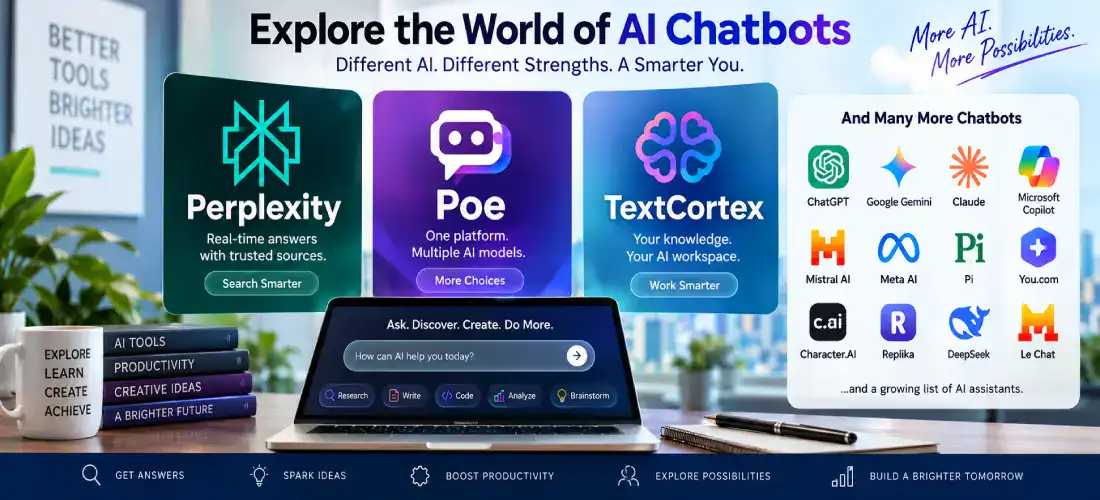
The market extends far beyond these four giants.
Perplexity is particularly compelling as an AI-powered research and search platform. Its emphasis on web research and citations makes it an excellent complement to conversational chatbots. Perplexity Pro currently costs US$20 per month and adds greater access to advanced models, Deep Research, higher limits, and other professional features.
Poe takes another approach. Rather than betting on one AI company, Poe provides access to numerous models from companies such as OpenAI, Anthropic, and Google through one platform. That makes it particularly attractive to people who enjoy comparing models without maintaining several separate subscriptions.
TextCortex focuses heavily on customizable AI, knowledge management, business information, and organizational workflows. Its Premium plan currently starts at US$29.99 per user per month and includes access to models from multiple AI providers.
Other competitors will continue emerging, while specialized AI assistants will increasingly target coding, research, medicine, education, business, creative production, and other fields.
Ultimately, there is no single “best” AI chatbot.
ChatGPT is arguably the strongest general-purpose choice. Gemini is especially compelling for people immersed in Google's ecosystem. Claude stands out for writing, coding, document-heavy work, and careful analysis, while Microsoft Copilot makes tremendous sense for people living inside Microsoft 365. Perplexity excels at AI-assisted research, while Poe and TextCortex show the growing appeal of platforms that give you access to multiple AI models.
The smartest strategy may not be choosing one chatbot forever. Instead, learn what each platform does particularly well and use the right AI for the right job.
The AI competition is only beginning—and by 2031, today's chatbots may look surprisingly primitive compared with the intelligent digital assistants that replace them.